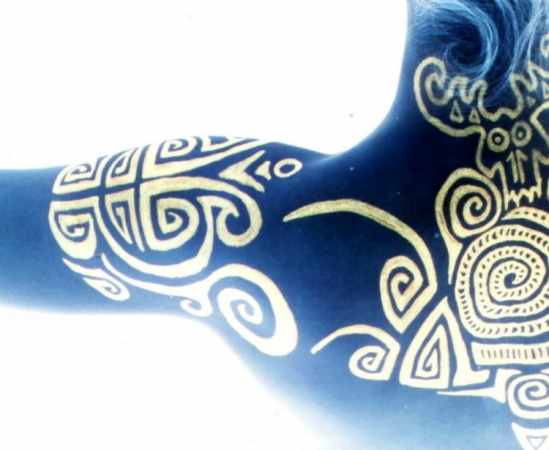
Make your own woad.
Woad - probably not the best product for bodyart but it's mistique is parallelled only by the megaliths themselves. But it is worth a try, you may have more success than me. Woad seeds can be obtained from most healthfood shops or garden centres now, ask for Isatis tinctoria. Don't worry if you haven't got green fingers you only need the leaves off one decent plant to make a dip and you get loads of seeds in a packet.
Growing the stuff's fairly straightforward. Plant your seeds in the garden / window box / whatever, in April to a depth of 2 inches or a good poke with your finger. Water regularily (twice I think I did it) and keep it weeded (also optional in my case). The first year you only get a tiny little thing (if neglected like mine) but the next year you get waist high things (no matter how inconsiderate a gardener you are). If you wait till you have a hundred leaves to pick, without taking more than a quarter off the plants, you should have a viable crop. Next step, the dying process.

First you need a big pan that you'll never be able to use for anything else again or preferably a big cauldron if you want to go fully ethnic. Drop two hand fulls of leaves into fast boiling water that already contains a pinch of cream of tartar. Keep the pot bubbling furiously for two to three minutes then remove the leaves. Having a strainer in the pot would have been good advice (but I didn't, so learn the hard way).
Now you must cool the liquid as quickly as possible. This is where I took the opportunity to destroy the rest of the kitchen. I decanted the mixture into another pan and ruined a marble rolling pin hoping to speed up the process. At this point add ammonia until the liquid is yellowish in colour. Allow to cool completely then start to re-heat after you've got your breath back. The mixture can be saved for later use at this point.

The target temperature for re-heat I've been informed is 60 degrees Centigrade, all the time keeping an eye that the mixture stays yellow with the odd sprinkling of ammonia. When you hit 60 add sodium dithionite to deoxidise the liquid (just do it, you don't need to know why). Then stir very gently so as not to splash (you are trying to keep out as much air as possible from the mixture) until a bronze scum appears.
THIS is the point where I may have gone wrong. The above recipe is for dying wool, right now you should be chucking in all your clothes, curtains and livestock.

I tried to apply the mixture as woad 'the body paint' at this point. Too runny and thin (and too hot too as I remember, can't be too sure, I was holding the brush). So we tried to reduce it by boiling, the paste once it was cool enough to apply, was still quite weak in it's effect, though the pale staining did hold definition for about four days. The next day we tried to 'revitalise' the solid residue which covered EVERYTHING in the house. That was the poorest result of all.
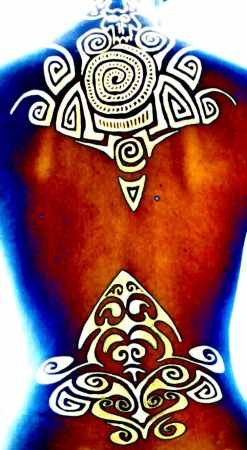
I've experimented with loads of materials for applying patterns to skin and have had varying degrees of success (I really don't like henna, it just doesn't feel right or look like the alternative to what woad would be to me). I'm still looking for something that will stain the skin blue for over two weeks but have so far been unsuccessful. I didn't like henna at all. Myself and Bekki have done a thousand searches and the closest we've come was security dyes. Unfortunately all the producers of these products informed us that the fast fixing dyes that are used to protect money are carcenogenic. Also the bullets that the guards have in their guns have a lethal amount of lead. So don't go knocking off any security vans hoping to get a cool temporary tattoo in the bargain.

So what's my point you may ask?
Well it's this, after all my experiments and research on woad and the short comings of it as a body dye, I'm still in love with the idea of it. I've come to the conclusion that 'if' it was used (and it is only later writers, not Julius Ceasar who talk of it) then it was probably used only for fabrics. Click HERE to see why.